Most business owners ask the wrong question first. They ask, "How much does a website cost?" when they should be asking, "Who owns everything when this is done, and what am I paying every month forever?" If you are looking for a web designer in Delaware, the quote is only part of the decision. The fine print is where the real cost lives.
Why 'how much does a website cost?' is the wrong first question
A $1,000 website can be expensive. A $4,000 website can be cheap.
That sounds backwards until you look past the launch price. The number on the proposal is not the full cost if you are also locked into hosting, platform fees, maintenance plans, required retainers, plugin fees, or a contract that makes it hard to leave.
I see this all the time. A business owner compares three website quotes and picks the lowest one because it looks responsible. Then six months later they realize they do not control the hosting, they cannot move the site easily, and every small change costs money. The site was not really cheaper. It was just priced in a way that hid the long-term cost.
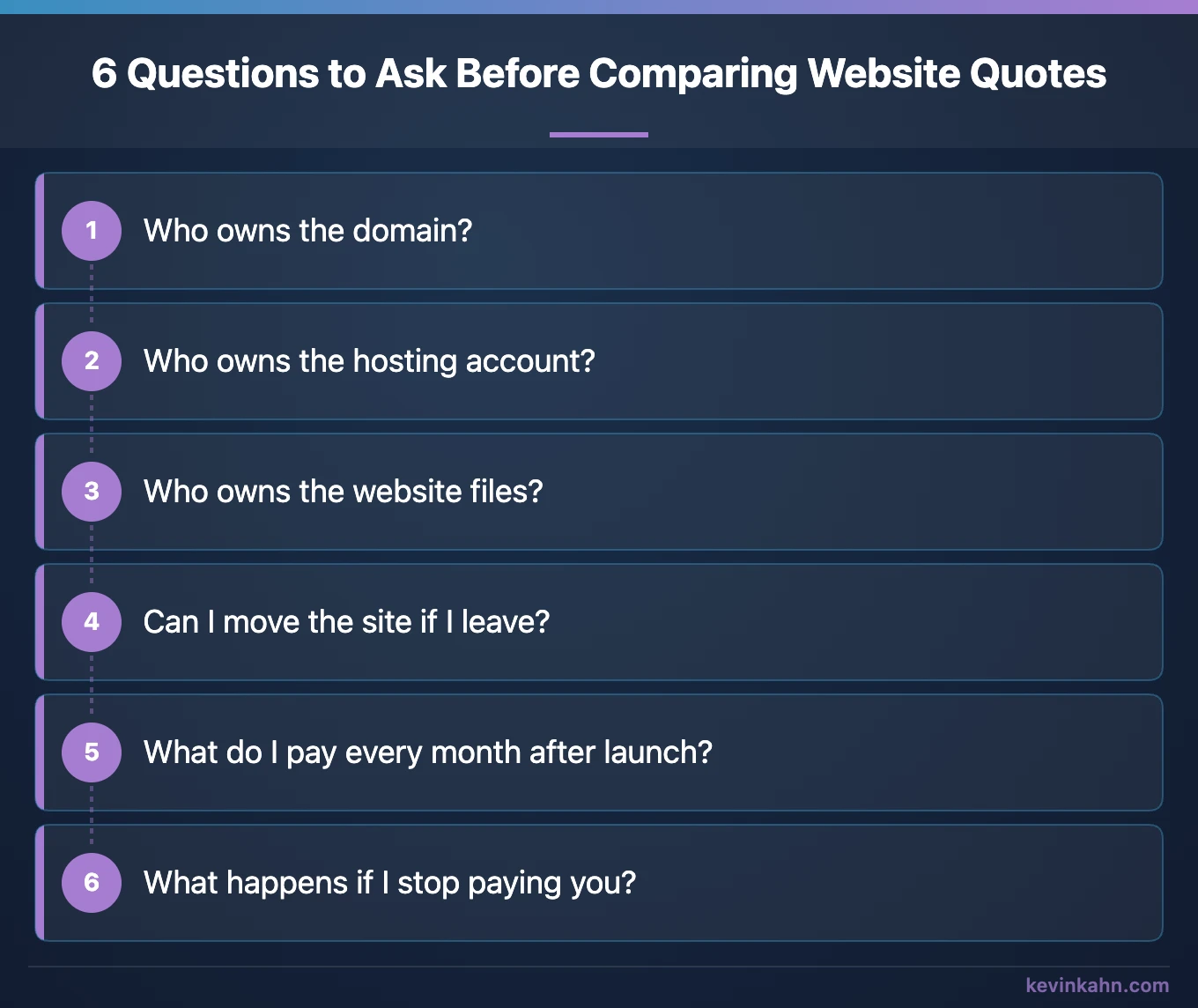
Before you compare design mockups or homepage layouts, ask these questions:
- Who owns the domain?
- Who owns the hosting account?
- Who owns the website files?
- Can I move the site if I leave?
- What do I pay every month after launch?
- What happens if I stop paying you?
That is the real starting point.
I am not saying every monthly fee is bad. Some businesses need active SEO, content, ads, reporting, support, or regular updates. That work has value. But a monthly fee should be tied to actual work, not just permission to keep your own small website online.
I wrote about this same ownership problem in why owning your website beats renting from Wix or GoDaddy. The same idea applies here. Your website should be an asset, not a subscription trap.
The client paying $750 a month for a small website
I am currently building a site for a client who was paying $750 a month for a short 2 to 3 page website with a light Mailchimp integration. That is $9,000 a year, every year!
There was not a huge custom system behind it. There was not some complicated software product. It was a small site with a simple email marketing connection. Nobody had walked them through what they were actually paying for.
Their new custom site will cost less than $3,000 one time. Once it is built, there will be $0 a month in website fees from me just to keep it online.
That does not mean there will never be costs anywhere. Domains renew, web apps with a database and email tools like Mailchimp may have their own fees depending on the account. But there is a big difference between normal direct business expenses and paying $750 a month forever for a small site because the contract was structured that way.
Most website quotes show you what you pay today. They don't always show you what you'll pay forever.
This is why I push clients to look at year two, not just month one. Month one is where cheap looks good. Year two is where the math usually tells the truth.
And no, I am not saying every web design company doing retainers is doing something wrong. A real retainer can make sense when there is real ongoing work. But if the site is small, stable, and only needs occasional updates, you should not be paying like someone is rebuilding it every month.
Who owns your domain, hosting, files, and content if you leave?
Ownership is boring until it becomes urgent, then it is everything. If your domain is in someone else's account, they control the front door to your business online. If your hosting is tied to their private setup, you may not be able to move your site cleanly. If your content, design files, or code are not yours, leaving can mean starting over.
Here is what I would ask any Delaware web design company before signing anything:
Do not accept vague answers like, "We take care of all that." That might be fine for convenience, but it is not an answer. You need to know who owns what.
Some companies keep everything inside their own platform because it makes support easier. I understand that. There is a trade-off. But easier for them can become restrictive for you. If you are paying for a business website, you should know whether you are buying an asset or renting access.
The monthly fee that makes a cheap website expensive
The cheapest website quote often wins because it feels safer, then the monthly fee shows up. A low upfront cost plus a required monthly plan can cost more in year two than a properly built custom site costs total. This is the part most business owners miss because they only compare the proposal totals, not the two-year cost.
Use simple math:
My pricing is public because I think it should be. I do not like mystery pricing for normal small business websites. The client example above is the clean version of the math: under $3,000 one time instead of $750 a month, which was $9,000 a year.
That is also why I wrote how much a website costs for a small business. The answer is not one number. It depends on scope, pages, writing, functionality, integrations, and how the site is built.
But the monthly part needs to be clear.
Ask what is required and what is optional. Required hosting through the designer is different from optional support. Required maintenance is different from paying hourly when you need help. Required platform fees are different from paying a normal hosting company directly.
A monthly fee is not automatically bad. A hidden or unnecessary monthly fee is.
Custom build or template: what are you actually getting?
If you need a simple online brochure, have a tight budget, and do not care much about custom layout, a template can be fine. It can get you online quickly. It can be enough for a business that just needs basic pages and contact information.
But you should know what you are getting. Templates usually come with limits. You work inside someone else's structure. You get extra code you may not need. You may fight the builder when you want something specific. Branding can start to look generic because the layout was not built around your business.
Custom work is different because the site is built around the content, the brand, the calls to action, and the way people actually use the site.
Performance is a good example. Hand-built sites can hit 98+ Google PageSpeed scores when they are built carefully. Template builders rarely do because they load extra scripts, builder code, fonts, widgets, and features whether you need them or not. The screenshot is a real result from a hardscaping site I built in Wilmington.
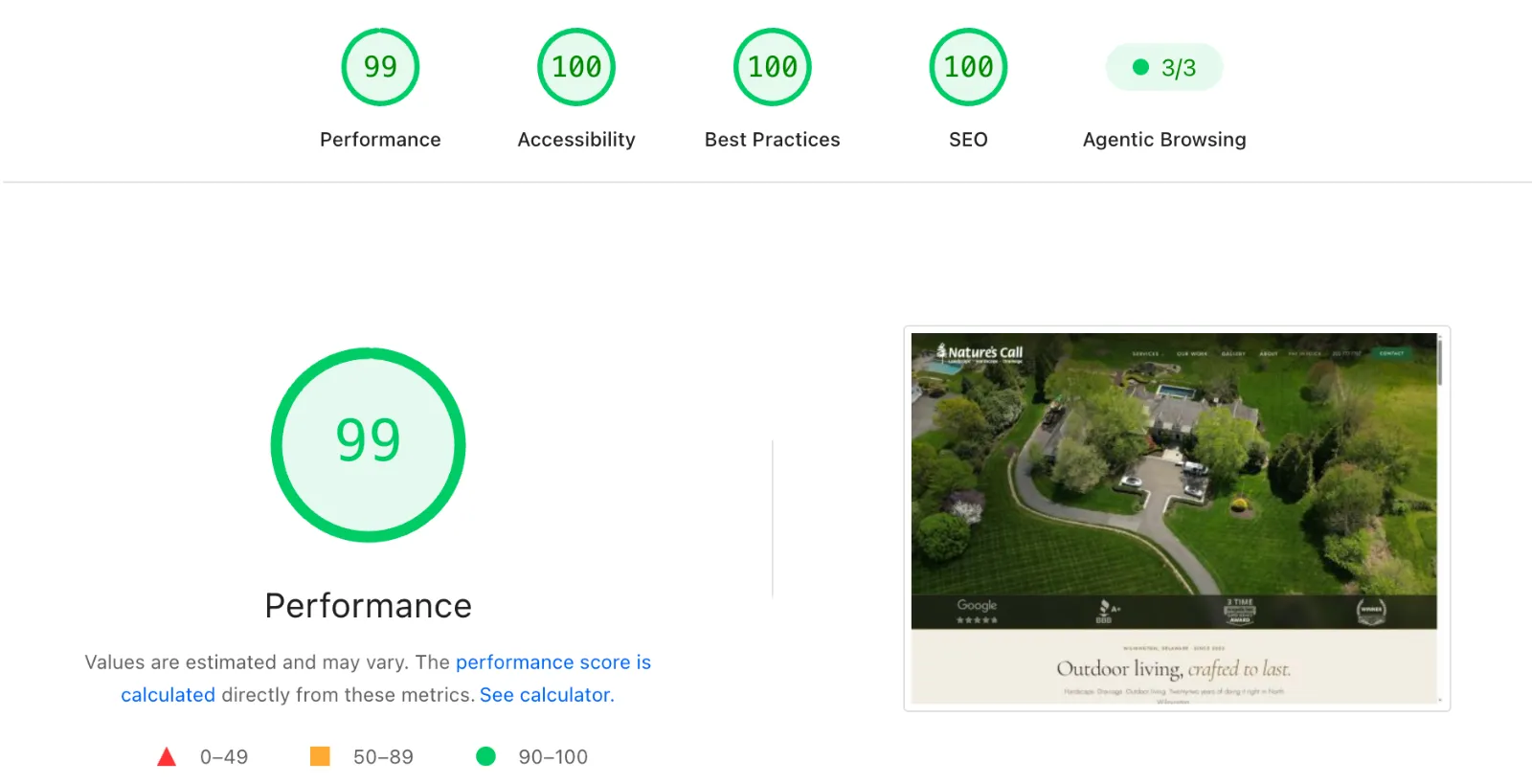
That matters for SEO. It matters for users on phones. It matters when someone clicks from Google and the page takes too long to respond.
Templates are fine when the site is not expected to do much. They start to cap growth when your website needs to rank, load fast, feel specific to your brand, or support more serious marketing.
Do you need a local web designer in Delaware?
A good remote web designer can build a good website. A bad local designer can still make a mess. Geography does not fix bad process, unclear pricing, or weak technical work. But local can matter for a host of reasons.
If you are hiring a web designer in Delaware, you may want someone you can actually meet. That matters when you want accountability. It matters when you prefer a real conversation instead of a ticket system. It matters when your business depends on local search, local trust, and the way people in Wilmington or New Castle County actually look for services.
Local also helps with context. Delaware is not a huge anonymous market, and website designers for small business owners here are a small circle. A small business website here often has to do several jobs at once: explain what you do, build trust quickly, show up in search, and make it easy for someone nearby to call, email, or request an estimate.
Here is when I think local matters most:
- You want to meet in person before signing.
- You care about local SEO and service-area visibility.
- You want someone who understands Delaware business expectations.
- You do not want to disappear into a national agency support queue.
- You want a long-term relationship without being locked into a long-term fee.
Local is not the whole decision. It is one factor. The better question is whether the person is clear, accountable, technically solid, and honest about what you will own when the project is done.
Questions to ask a Delaware web designer before you sign
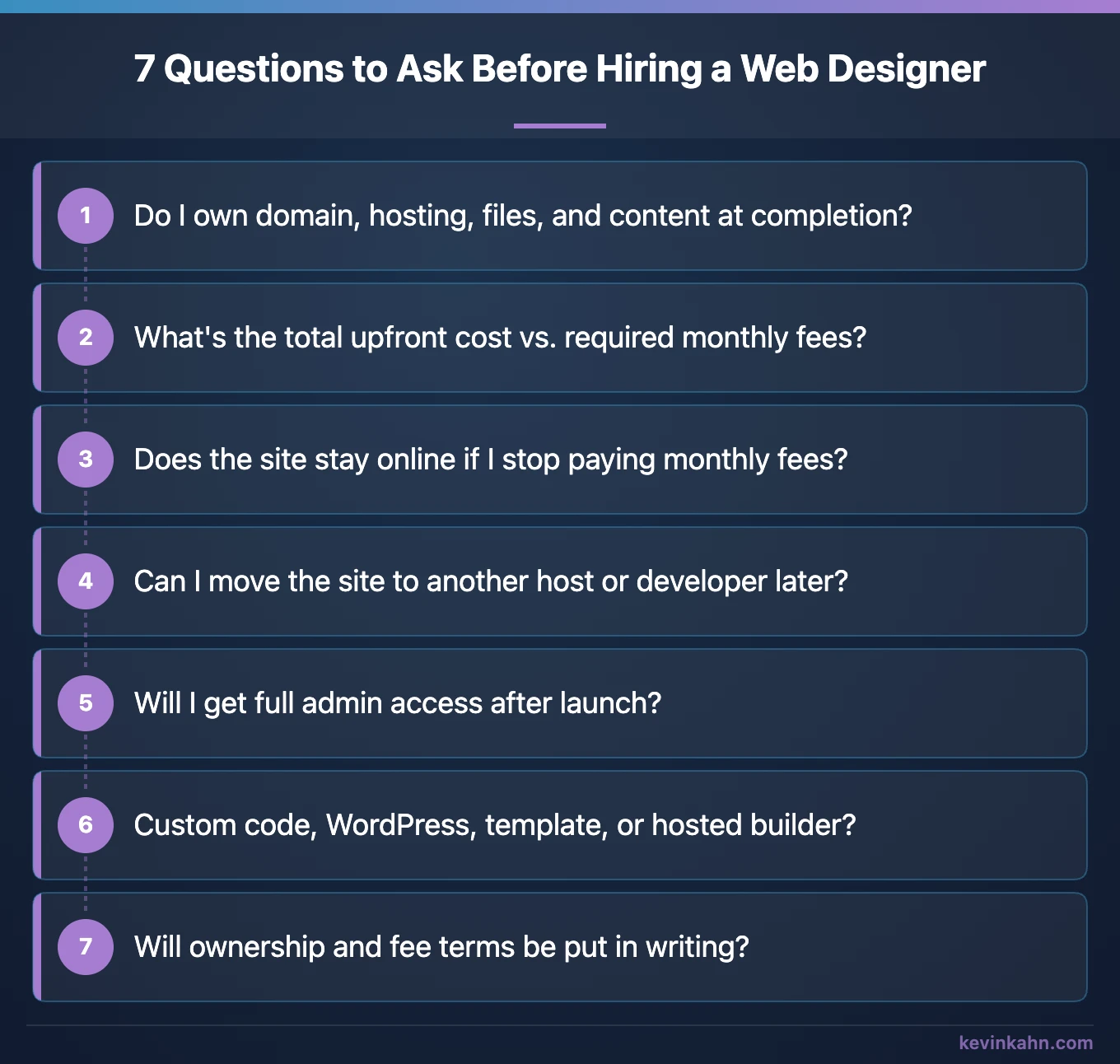
Copy and paste these into an email before you hire anyone.
Seriously. The answers will tell you more than the portfolio.
- Will I own the domain, hosting account, website files, and content when the project is done?
- What is the total upfront cost for the website and monthly fees after launch?
- If I stop paying a monthly fee, does my website stay online?
- Can I move the site to another host or developer later?
- What PageSpeed score do you typically aim for on mobile and desktop and can you show me a recent example?
- Are you building custom code, using WordPress, using a template, or using a hosted builder?
- Do you charge hourly for updates, require a plan, or include some support?
- What happens if we part ways?
If someone gets annoyed by those questions, that is useful information.
You are not being difficult. You are protecting your business. A website is not just a design project. It is your domain, your content, your search visibility, your lead flow, and often your first impression.
If you want a second set of eyes on a quote, or you want to talk through what you actually need before you spend money, reach out. I will tell you what I think, even if that means telling you a cheaper option is fine.