I saw a sponsored ad this week that stopped me mid-scroll. It was targeting home service businesses, and the headline was something like: "Get a Free Website Built for Your Business." Clean design, friendly copy, a big green button. Sounds like a great deal until you read the fine print. That "free" website comes with a $97/month commitment. Forever. No exit. No files to take with you. Just a monthly bill that never ends. This is one of the more common traps I see when talking to small business owners about web design in Wilmington, Delaware and across the state, and it's worth slowing down to do the actual math before you click that button.
That Sponsored Ad Promising a 'Free Website' for Home Service Businesses
The ad I saw was polished. Professional. Aimed squarely at contractors, landscapers, and other home service businesses who need a web presence but don't want the headache of building one from scratch. The pitch was: we build your site at no upfront cost, you just pay the monthly fee to keep it live.
That framing is deliberately confusing. "Free" implies you're getting something. What you're actually doing is signing up for a subscription where the product, the website itself, never becomes yours.
The $97/month fee was buried in the terms. Not in the headline, not in the subheading. In a block of small text below the fold that most people scroll past. I've talked to plenty of Delaware business owners who fell into exactly this trap. They signed up, had a decent-looking site for a year or two, and then when they finally wanted to move on, they found out they couldn't take anything with them. No files. No content. They had to start from scratch.
That's the part the ad doesn't mention. And it's the part that matters most.
What $97 a Month Actually Adds Up to Over 3 Years
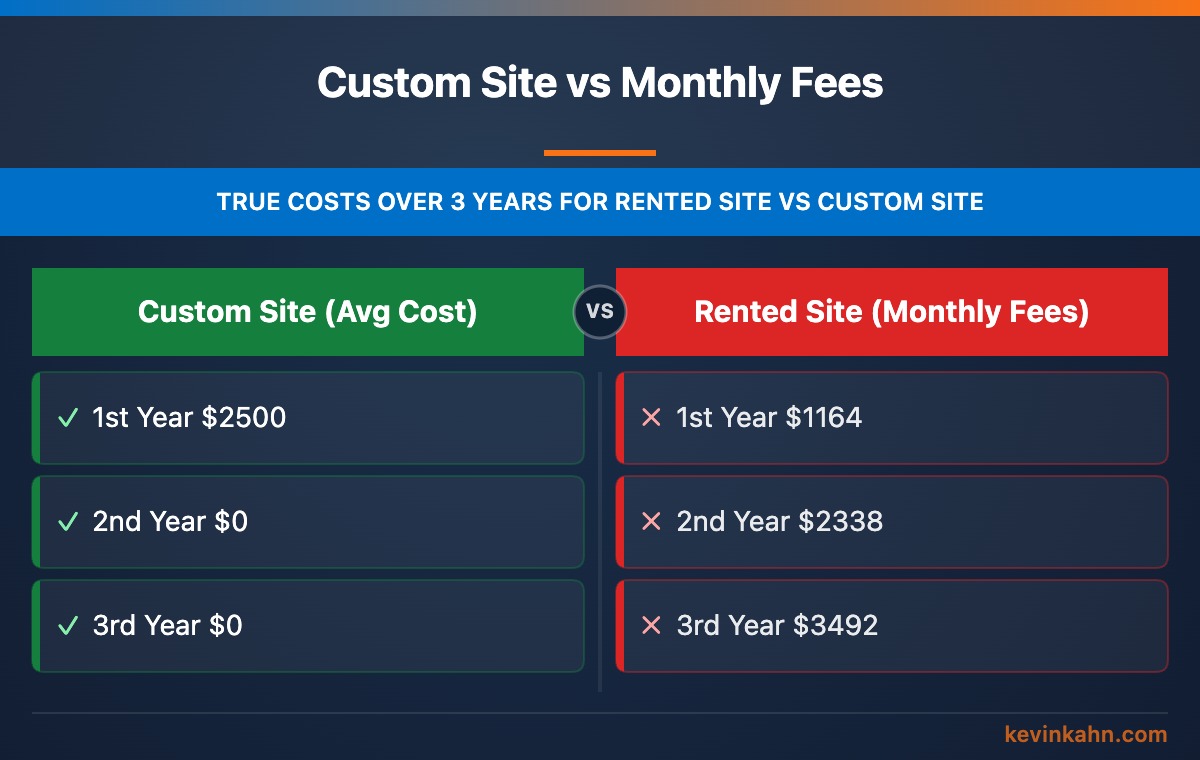
Let's just do the math. Plainly.
Now compare that to a custom-built website with a one-time cost. A professionally designed site for a small business typically runs somewhere in the $2,000 to $3,000 range depending on complexity. After that, you're paying for hosting, which usually can run $20 to $50 per month on sites like Wix / GoDaddy but are completely FREE on Cloudflare (yep $0/month). You own the files. You own the domain. You can move hosts if you want. You can hire a different developer. Nobody can pull the plug on you.
By month 36 on the "free" plan, you've paid more than the cost of a custom site and still have nothing to show for it in terms of actual ownership. The math isn't close. It's not even a question of trade-offs. It's a question of whether you realized what you were buying.
Most people don't realize it until they try to leave.
When Does a Monthly Fee Actually Make Sense?
I don't want to pretend all monthly fees are a scam. They're not. There are legitimate reasons to pay ongoing costs for web-related services.
If your site has a real backend, a customer portal, a booking database, a membership system, those features require real infrastructure and often real maintenance. Monthly fees for that kind of functionality usually reflect actual work being done on your behalf.
Same goes for services like SEO, content updates, or social media management. Those are ongoing services, not a product, and monthly billing makes sense for them.
But SEO is where I'd urge the most caution. It's one of the most oversold services in the industry. You'll see agencies promise first-page rankings or guaranteed results, and that should be an immediate red flag. No one can guarantee a Google ranking. The algorithm doesn't work that way, and anyone telling you otherwise is either misinformed or misleading you.
What legitimate SEO work actually looks like is less glamorous: clean site structure, fast load times, accurate business listings, relevant content written for real people, and patience. It's not a magic lever. It's a long-term investment in doing things the right way. A good SEO partner will set realistic expectations, explain what they're doing and why, and show you progress over time, not just hand you a ranking report full of vanity metrics.
If someone is charging you monthly for SEO, the questions to ask are: what specifically are you doing each month, how will we measure it, and what do I own if we stop working together? If they can't answer those clearly, that's your answer.
The line that matters: monthly fees for services are fine. Monthly fees tied to whether your website continues to exist are not. You should own your site outright first. Then decide what services you want to pay for on top of it.
The problem with the "free website" model is that the fee isn't for a service. It's a ransom. Pay it and your site stays up. Stop paying and everything disappears. That's not a service relationship. That's leverage being held over you.
Own the asset first. Layer services on top of it. That's the order that protects you.
The Part Nobody Mentions: When You Decide to Move On
Here's something worth understanding before you sign up for one of these platforms: what happens when you want to leave. With most subscription-based website builders, the site lives entirely on their infrastructure. That means when you cancel, you're not walking away with a copy of your website. The files, the images, the content you wrote or paid someone to write, none of that transfers automatically. If the domain was registered through their platform, that can get complicated too.
This isn't unique to shady companies. It's just how these platforms are built. The monthly fee covers access, not ownership.
Think of it like renting office space. There's nothing wrong with renting, and it makes sense for a lot of situations. But if you spend years decorating and improving a rented space, you don't get to take the walls with you when you leave. You're improving someone else's asset, not building your own.
The main thing I'd want any business owner to know going in is just that: understand what you're paying for. If it's access to a platform, that's fine as long as it fits your situation. Just go in with eyes open, because the ads selling these services rarely explain what leaving looks like.
What 'Owning Your Website' Actually Means in Plain Terms
Ownership isn't complicated, but it has specific, practical meaning. Before you sign anything with any web vendor, here's what you should be able to confirm:
That's what ownership looks like. If a vendor can't confirm all of those things upfront, you're not buying a website. You're renting one.
How to Spot a Rental Deal Before You're Locked In
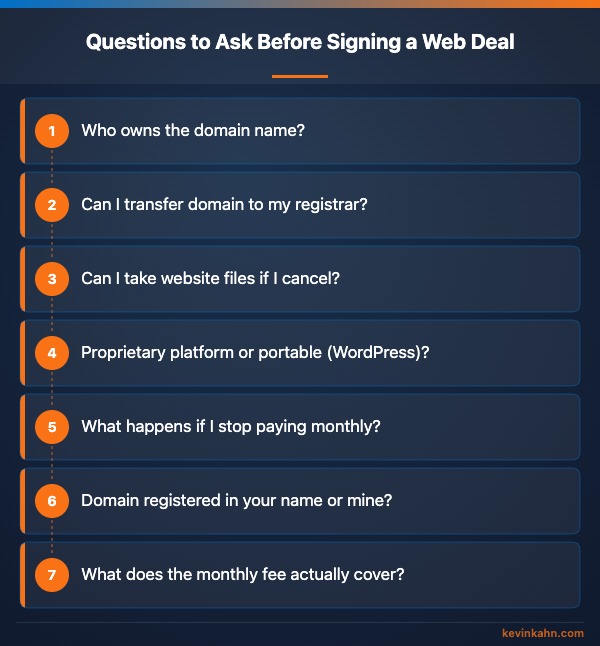
Before you sign a contract or hand over a credit card, ask these questions directly:
- Who owns the domain name, and can I transfer it to my own registrar?
- If I cancel, can I take the website files with me?
- Is the site built on a proprietary platform or a portable one like WordPress?
- What happens to my site if I stop paying your monthly fee?
- Are you registering the domain in your name or mine?
- What exactly does the monthly fee cover, and is any part of it tied to site ownership?
If the answers are vague, or if the salesperson pivots instead of answering directly, that tells you something. Legitimate vendors have nothing to hide in those answers.
If you're a small business owner looking at your web options and want a straight conversation about what you'd actually own, reach out. I'll tell you what the right setup looks like for your situation, without a pitch attached.