Southeastern Executive Health
Case StudyA private-pay psychiatry practice in Chadds Ford, Pennsylvania, serving southeastern PA and northern Delaware. The practice moved off WordPress onto a hand-built static site with a full structured-data graph, a redirect map that preserved every indexed page, and an intake architecture designed so that no patient health information ever reaches the website.
Visit MyExecutiveHealth.com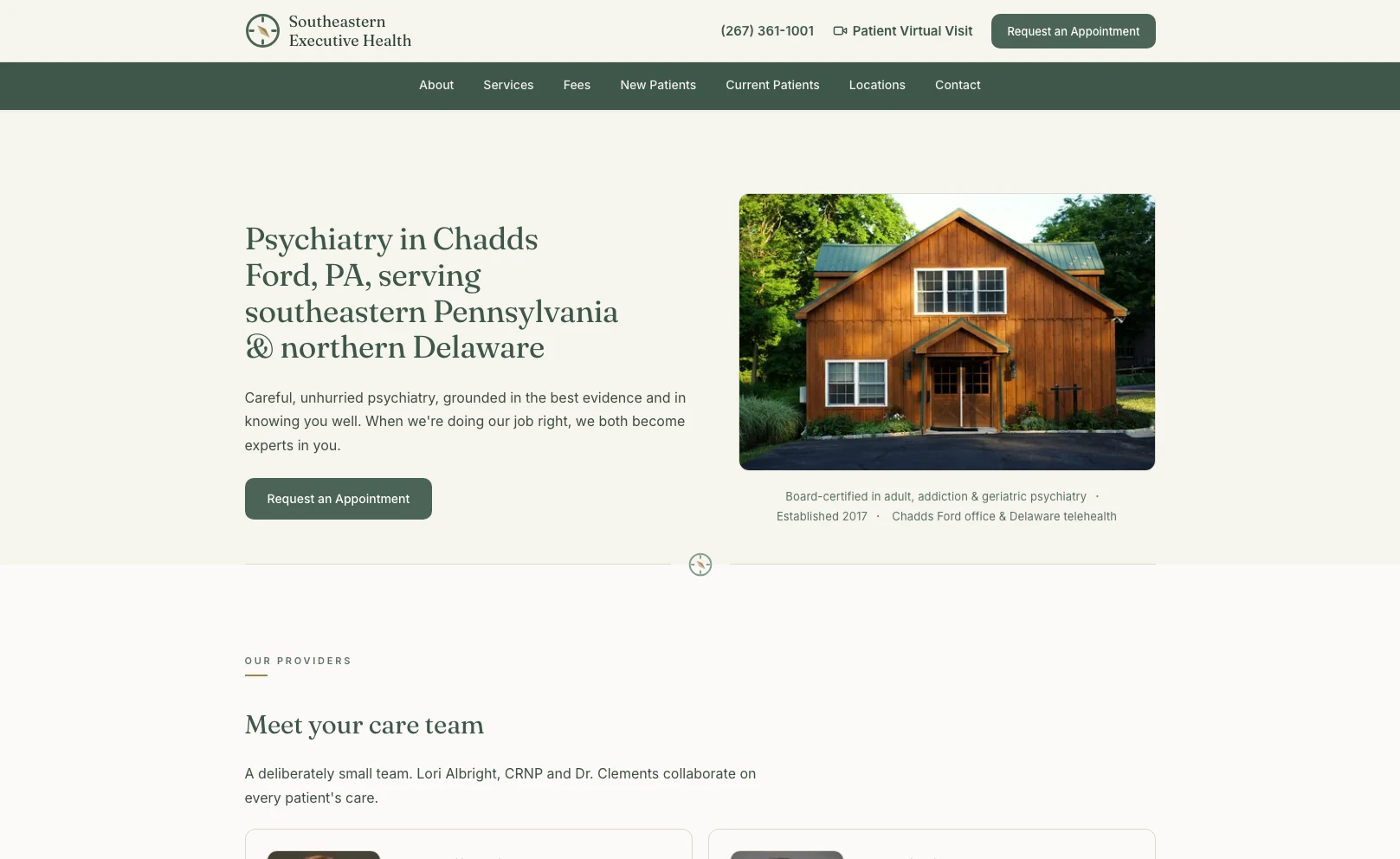
Results at a Glance
Google PageSpeed Insights
I read these scores on October 5, 2026. PageSpeed moves a few points from run to run, so a fresh test may land slightly higher or lower. Run it yourself on PageSpeed Insights, or see the site's structured data in Google's Rich Results Test.
Core Web Vitals
Total Blocking Time measures 0 ms on both mobile and desktop, because there is no client-side framework to hydrate. Cumulative Layout Shift is 0.014 on desktop and 0.054 on mobile, both inside Google’s “good” range. On desktop, Largest Contentful Paint lands at 0.5s and First Contentful Paint at 0.3s.
About that mobile Performance score
Desktop Performance is a straight 100. Mobile comes in at 96, and one metric accounts for the gap: Largest Contentful Paint at 2.6 seconds on a throttled mobile connection. It is the only measurement on the page that is not in the green.
Everything else maxes out. 100 for Accessibility, Best Practices, and SEO on both mobile and desktop, 0 ms of blocking time on both, and layout shift well inside the good range. A practice website is worth judging on whether it loads fast and reads clearly, and this one does. Anyone can run the report themselves in about ten seconds.
The Bottom Line
What the build gives the practice, in plain terms:
- A site that loads immediately and reads as carefully made as the care it describes.
- Thirteen pages that search engines and AI assistants can parse without guessing.
- Every page indexed on the old WordPress site still lands somewhere useful.
- Patient forms that route through the practice management system, never through the website.
- A test suite that fails the build if the site starts saying something it should not.
Project Overview
Southeastern Executive Health is a private-pay, out-of-network psychiatry practice in Chadds Ford, Pennsylvania, run by Dr. David Clements IV, MD, alongside Lori Albright, CRNP. The practice sees patients in the Chadds Ford office and by telehealth across Pennsylvania and Delaware, so the site had to speak clearly to both an in-person and a virtual patient.
The existing site ran on WordPress with Elementor. The rebuild replaced it with a static Astro site on Cloudflare Pages: thirteen pages, a structured-data graph spanning all of them, a content layer the practice can edit through a CMS, and a test suite that runs against the built HTML. It went live on August 12, 2026.
A medical practice website carries an obligation an ordinary small-business site does not. Anything a patient types has to be treated as protected health information, and the safest place for a website to put that data is nowhere. That constraint shaped the architecture more than any design decision did.
Page Structure
Thirteen pages, organized around how someone actually arrives at a psychiatry practice:
Moving Off WordPress Without Dropping the Old Site
A rebuild is the moment a site is most likely to lose the search equity it spent years earning. The old WordPress install had pages that Google had indexed and that other sites linked to. Every one of them needed somewhere to land.
Keeping Patient Information Off the Website
This is the decision the whole build turns on. A psychiatry practice needs patients to request appointments, ask for refills, and reschedule. Every one of those is a form. And every one of those forms, if it lived on the website, would put protected health information onto infrastructure that is not covered for it.
So the website collects none of it. Patient forms are hosted inside the practice’s own management system, and the site links or embeds rather than receives. There is no form endpoint on our stack, no webhook pointing back at the domain, and no database. The website’s job is to get the right patient to the right form and then get out of the way.
Nothing here is legal advice, and the practice’s compliance obligations are its own. What the build controls is the architecture, and the architecture keeps the website out of the path of patient data entirely.
Tests That Guard the Content, Not Just the Code
Most small-business websites have no tests at all. This one has 39, and the interesting ones do not check whether the code runs. They check whether the site is still saying true things. On a medical site, a sentence that drifts out of date is a bigger risk than a broken button.
Never Publish a Claim That Is Not True
Where structured data can state something about a provider that changes over time, the build emits the property only when it is affirmatively true and omits it otherwise. A test enforces that, because publishing a false value and publishing nothing are very different things to a search engine.
No Address Where There Is No Office
Delaware is telehealth only. A test asserts the Delaware page emits telehealth schema with no postal address, so the practice never appears to have an office it does not have.
Every Page Has a Real H1
The old site shipped empty H1 elements on its provider pages. A test now walks the built HTML and fails if any key page is missing a non-empty H1.
Valid Structured Data, Every Build
Every JSON-LD block on every page is parsed and checked for a valid context. Broken schema is invisible in a browser and costly in search.
Correct Opening Hours
The site was emitting a human-readable day range where schema.org expects enumerated day values, so Google could not read the hours at all. A helper and four unit tests fixed it and keep it fixed.
No Placeholder Text Ships
A cruft check fails the build if draft placeholder language survives into production. On a site written across many sessions, this is the test that earns its keep most often.
Medically Reviewed Byline Where It Belongs
A test asserts the byline appears on the page that needs it and not on the one that does not.
Seven test files run against both the source data and the built HTML output. The build-output tests are the ones that matter most, because they check what a patient and a crawler actually receive rather than what the templates intended to produce.
SEO Strategy
The practice competes in a narrow geography along the Pennsylvania and Delaware border, so the strategy is local and specific rather than broad. The site is built as one connected graph of entities: a practice, a clinic with an address, two clinicians, three services, and a telehealth channel, all linked to each other by identifier.
A Linked Schema Graph
The homepage emits an Organization and MedicalBusiness node plus a WebSite node. Provider pages emit Physician nodes carrying credentials, specialties, and NPI, each linked back to the clinic and to each other as colleagues.
A Real Clinic Node
The Chadds Ford page carries a MedicalClinic with a full postal address, geo coordinates, and enumerated opening hours. This is the node local search actually reads.
31 FAQ Questions in Schema
Five pages emit FAQPage structured data totalling 31 question and answer pairs, covering private pay, insurance, first visits, refills, and telehealth across state lines.
Telehealth Modeled Accurately
Delaware is a ServiceChannel with an area served, not a second location. The practice gets credit for serving Delaware without claiming an address it does not have.
Geography in the Title and H1
The homepage title and H1 both name Chadds Ford, PA and Wilmington, DE, because those are the searches that matter to a practice with one office.
Breadcrumbs and Clean Structure
Six pages emit BreadcrumbList data, and every page uses a single H1 with a logical heading hierarchy underneath it.
A flat sitemap carries a real last-modified date per page, pulled from the commit history rather than from the build clock, so search engines get an accurate signal about what actually changed.
Design and Mobile Experience
The design brief was unusual for a medical site. Most psychiatry practices online look either clinical or corporate. This one needed to feel like the office it describes: a converted barn on wooded grounds in Chadds Ford.
Accessibility
The site scores 100 for Accessibility on both mobile and desktop. For a psychiatry practice this is not a checkbox. People arrive at this site while unwell, sometimes on an old phone, sometimes using a screen reader, and the site should not add friction to that.
Security
A static site removes most of the attack surface a WordPress install carries. There is no database, no plugin ecosystem, and no admin login on the public site to brute-force. What remains is worth doing carefully.
AI Discoverability
People increasingly ask an assistant for a psychiatrist near them rather than typing it into a search box. An assistant can only recommend a practice it can read and resolve to a real place, and the deciding factor is usually whether the page makes sense without running any JavaScript.
Analytics & Tech Stack
The site uses Umami, a privacy-friendly analytics tool that sets no cookies and therefore needs no consent banner. Every outbound link to a patient form carries a custom event, so the practice can see how many visitors reach the point of starting an intake form and which page sent them there.
Those events record intent to start, not submissions. Submissions live in the practice management system where the clinical data belongs, and the website deliberately never learns about them. A test asserts that every intake link carries its event, so a new link cannot be added without tracking.
Technology Stack
| Component | Technology |
|---|---|
| Site Generator | Astro 5 (static output) |
| Hosting | Cloudflare Pages (migrated off WordPress / Elementor) |
| Content Editing | Keystatic CMS, editing Markdown and YAML in the repository |
| Fonts | Self-hosted variable Fraunces, Inter, and Lora |
| Patient Forms | Hosted in the practice management system, linked and embedded only |
| Analytics | Umami (cookieless, custom intake events) |
| Structured Data | JSON-LD graph: Organization / MedicalBusiness, MedicalClinic, Physician, MedicalProcedure, ServiceChannel, OfferCatalog, FAQPage, BreadcrumbList |
| Redirects & Headers | Cloudflare _redirects (36 rules) and _headers (HSTS, X-Frame-Options, Permissions-Policy) |
| Sitemap | Hand-rolled flat sitemap with per-page lastmod from git history |
| Testing | Vitest, 39 tests across 7 files, unit plus build-output |
Kevin is a skilled, responsive, intelligent, problem solver, who completely changed our digital presence at an incredibly reasonable rate. I cannot recommend his services highly enough.
Have a Site That Needs to Get This Right?
Whether your business handles sensitive information or simply needs to be found by the right people nearby, I build sites that are fast, accurate, and structured so search engines and AI assistants can recommend you with confidence. That can mean a website redesign like this one, a brand-new custom website design, or focused local SEO work on the site you already have.