Most small business owners I talk to ask the same two questions about social media. How do I get more followers and should I hire someone to handle my posting? Those aren't bad questions. But they're the wrong place to start. Social media marketing for small businesses in Delaware works best when it's built on top of something solid, a good website, consistent contact information, real reviews, and most importantly, a product or service worth talking about. Without that foundation, social media is just noise. Here's how to think about it, in the order that actually matters.
Why 'Get More Followers' Is the Wrong Place to Start
Followers feel like progress. The number goes up, the account looks active, and it's easy to mistake that for traction. But a local plumber in Wilmington with 400 followers and a working contact form will get more calls than one with 4,000 followers and a website that hasn't been updated since 2019.
The real goal of social media for a local service business isn't audience size. It's getting found by the right people, building enough trust that they reach out, and making it easy for them to do that. Followers are a byproduct of doing those things well. They're not the engine.
When you reframe the goal that way, your priorities shift. You stop obsessing over posting frequency and start asking whether someone who lands on your profile can figure out what you do, where you're located, and how to contact you. You start thinking about whether your website actually does something useful when someone clicks the link in your bio.
Social media is one channel. It points people somewhere. Where it points them matters more than how many people see the post.
What a $200/Month Social Media Plan Actually Looked Like for One Delaware Small Business
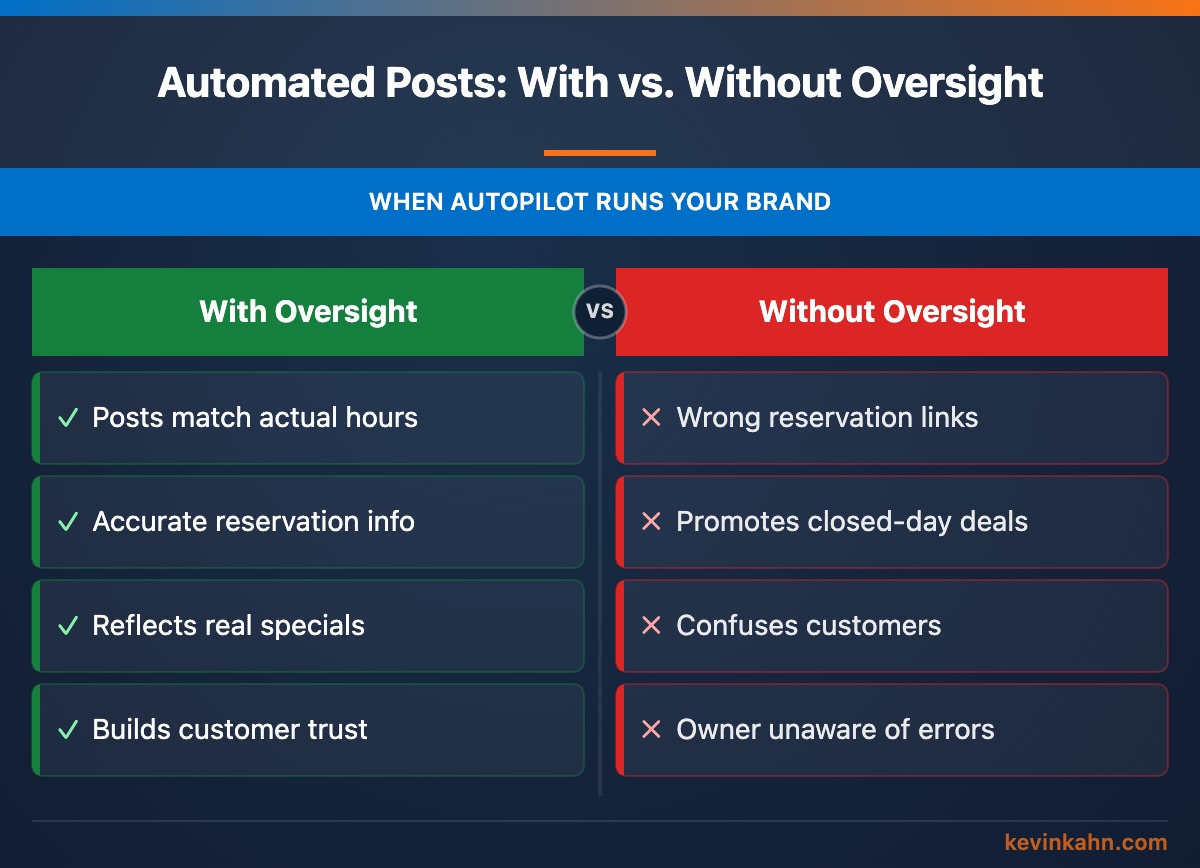
I was working with a local restaurant here in Delaware that was paying $200 a month for their website and automated social media posts on Facebook and Instagram. On paper, it sounded like they had things covered. Posts were going out regularly, the accounts looked active, and someone else was handling it.
When you actually looked at what was being posted, it fell apart. Posts encouraging customers to make a reservation online when there was no way to make a reservation on their website. Food specials being promoted on days the restaurant wasn't even open. The content looked fine at a glance, but it wasn't connected to how the business actually worked.
That's $2,400 a year, and the posts were actually creating more confusion than clarity. The owner had no idea because they trusted it was being handled. And that's totally understandable. They were busy running their business. But here's the thing. Automation can save you a ton of time, but only if the content actually reflects your business.
Automation isn't the problem. Automation without oversight is. Someone needs to know your business well enough to catch when a post says something that isn't true.
Before You Post Anything: The Online Basics Delaware Businesses Need to Know
Before social media enters the conversation, there's a layer underneath it that most local businesses either rush past or ignore entirely. Get this right first.
None of this is exciting. But it's the layer that everything else depends on.
Your Website Is Where Social Media Sends People. Make Sure It's Ready.
Every social media post you publish is pointing people somewhere. Usually your website. If that website doesn't do its job, the post was wasted.
What does "doing its job" mean for a local service business? It's not about being beautiful. It's about being clear. Someone lands on your homepage and within a few seconds they should know what you do, where you're located, and how to reach you. A phone number that's easy to find. A contact form that works. A call to action that makes sense for how your business actually operates.
I see businesses spend real money driving traffic to websites that make people work too hard. No phone number above the fold. A contact form that asks for ten fields before you can send a message. Service pages that describe what a company does in vague, general terms without mentioning the specific towns or areas they serve.
Your website is the hub. Social media, Google, word of mouth, they all point back to it. A well-designed site built around how your customers actually find and contact you will outperform a pretty one with no clear path forward every time.
What Social Media Is Actually Good For (When the Foundation Is Solid)
Once the basics are in place, social media has a real job to do for a local service business. It's just not the job most people think it is.
For small businesses in Delaware, Instagram and Facebook aren't primarily about acquiring new customers cold. They're about staying on the radar of people who already know you. Past clients, current clients, neighbors who've heard your name. Regular posts keep you visible to that warm audience without requiring them to actively think about you.
Posting consistently, even a few times a week, means that when someone in your network needs what you offer, or knows someone who does, you're the name that comes to mind. That's the real value. Not viral reach. Quiet, steady visibility with people who are already inclined to trust you.
Content doesn't need to be complicated. Finished projects. Behind-the-scenes moments. A quick tip that's actually useful to your audience. Responses to comments. Showing up as a real business run by real people goes further than polished promotional graphics.
Social media is a reminder system for your warm network. Build it that way and it works. Treat it like an advertising channel to strangers and you'll be disappointed.
Automation Tools vs. Hiring Someone: What Each Option Actually Costs You
There are tools built specifically to make social media posting easier for small businesses. Blaze and Marblism are two that come up often. Both have starter plans in the range of a few hundred dollars a month and can automate content creation and scheduling across platforms. If you're stretched thin and just need something going out consistently, they can help.
But here's what they don't solve:
Hiring someone to manage your social media costs more. A part-time social media manager or a local agency will run you more per month than an automation tool. What you're paying for is judgment. Someone who learns your business, understands your audience, and notices when something doesn't make sense before it gets posted.
For most small businesses, the real answer is: a modest tool plus 30 minutes a week of your own attention beats expensive automation you never look at.
The Thing That Beats Every Marketing Tactic: Word of Mouth From a Great Business
Here's the part nobody wants to hear because it's not a tactic you can buy: if your product or service is genuinely good, people will tell other people. That referral traffic converts at a rate nothing else comes close to. A friend's recommendation carries more weight than any ad, any follower count, any perfectly scheduled post.
This isn't me being idealistic. It's the most consistent thing I've observed over 25 years of working with small businesses. The ones that grow steadily and don't have to scramble for clients are almost always the ones where existing customers are doing the talking.
Social media supports that. Reviews accelerate it. A good website captures it. But none of those things replace it.
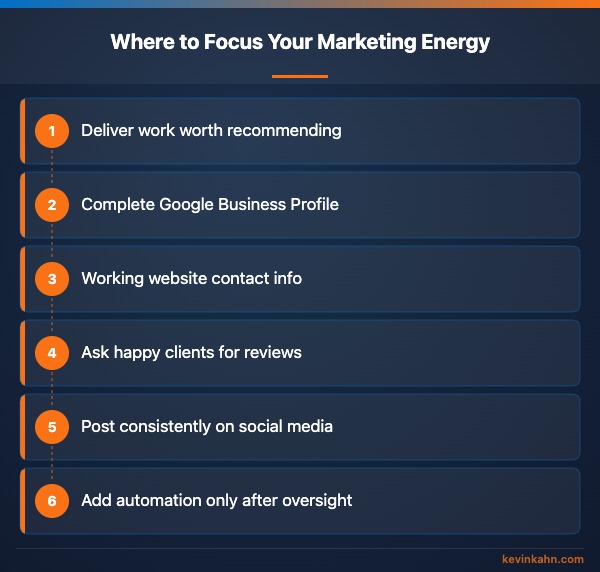
So here's a prioritized list of where to actually focus your energy:
- Deliver work that people feel good recommending
- Get your NAP consistent and your Google Business Profile complete
- Make sure your website has a clear contact method and accurate information
- Ask happy clients for reviews
- Post consistently on social media to stay visible to your warm network
- Consider automation tools only after you have oversight in place
Start at the top and work down. Most businesses I talk to are trying to fix the bottom of this list when the top hasn't been addressed yet.
If you're a Delaware small business trying to figure out where your time and money should actually go, reach out. I'm happy to take a look at what you have and tell you where the gaps are.