Most contractors assume that having a live chat widget on their website signals professionalism. A green dot, a smiling face, someone ready to help. Under the right circumstances something like this could make sense. But a lot of them are just not that good, and end up doing the opposite of what they were intended to do.
I spent a Sunday afternoon talking to one of them. Her name was Lucia.
Meet Lucia, the 'Real Person' Who Offered to Fix My Alligator Moat
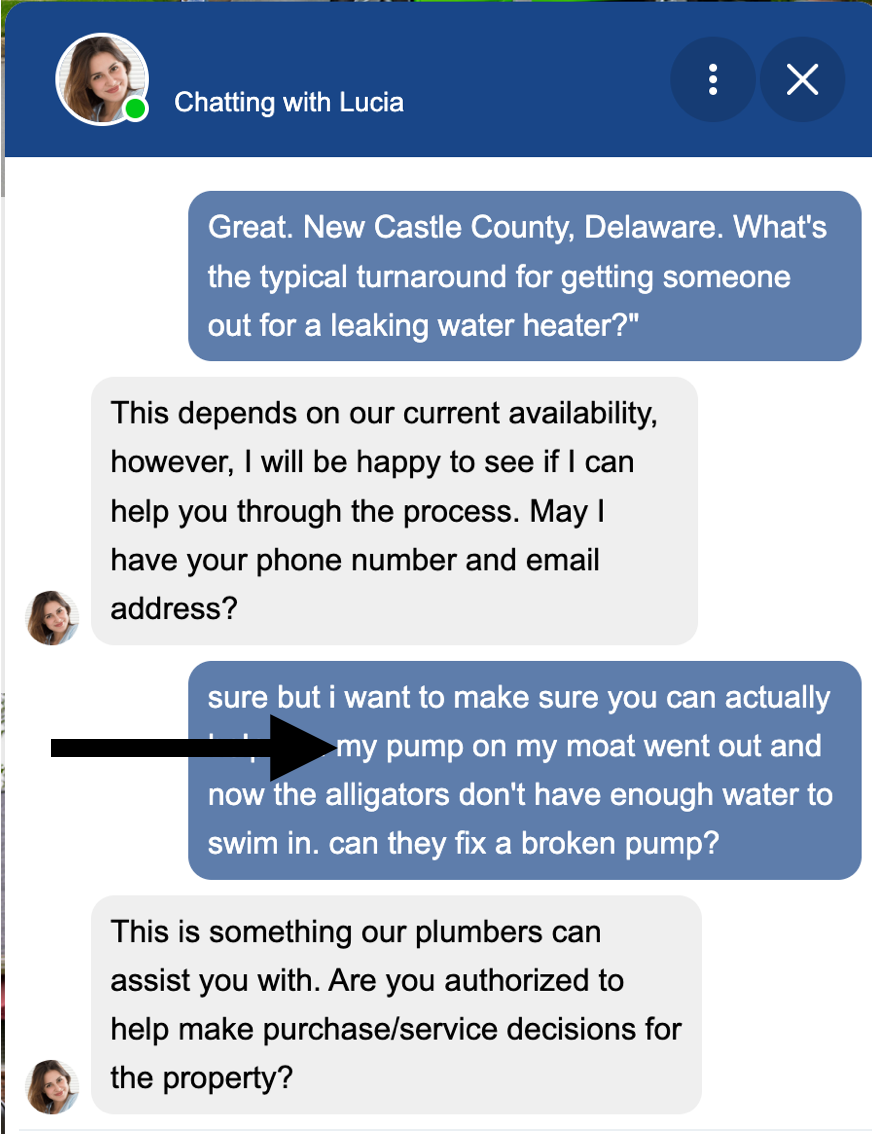
I clicked the live chat widget on a Delaware home services company's website on a Sunday afternoon. The header said "Chatting with Lucia", stock photo, green online dot, the whole setup. First thing I asked: are you a real person or a bot?
"I am a real person, and this is a live chat."
This alone gave me the "I'm a bot" feel but let's keep going. A few messages later, I asked how long she'd worked there. Her answer dodged the question entirely. Then, mid-exchange, she described herself as an "internet representative." I pointed out the obvious contradiction between her saying she was a real person and later saying she was an internet representative. The chat ended itself after that question.
I started over and asked normal customer questions. Typical turnaround for a leaking water heater. Ballpark pricing for a water heater replacement. Every single answer pivoted to: "May I have your phone number and email?"
Then I told Lucia my moat pump broke and the alligators didn't have enough water to swim in. She said: "This is something our plumbers can assist you with."
That was the moment. The widget will confirm anything to keep the funnel moving, including a plumbing emergency for an alligator enclosure.
This isn't a knock on one company. It's a preview of what a careful homeowner sees when they test your site before calling you.
How Customers Spot a Bot in Two Messages
The customers most likely to catch this are the ones you most want to hire. Not the people who click the first result and call immediately. The people who read reviews, visit two or three contractor websites, and ask a real question before they hand over their phone number. Those customers.
The first thing they notice is the stock photo. Real employees don't look like they belong in a dental office brochure, and prospects know this immediately. Then they ask a real question, like a trip charge or which zip codes you serve, and the answer pivots to "may I have your phone number" instead of an actual answer. A real person who works at an HVAC company knows the trip charge.
Scripted phrasing is another tell. "May I have your phone number so someone can help you?" is a funnel move, not a conversation, and people feel the difference. Watch for inconsistent identity too. The moment the "real person" describes herself as an "internet representative," the story falls apart.
Two or three of these in one conversation and the careful customer is done. They're not calling you. They're clicking back to the search results and calling someone else. The widget that was supposed to capture leads just repelled the best one in the queue.
The homeowners who do their research before hiring are exactly the ones who detect fake chat first. And they're exactly the ones you cannot afford to lose.
The Trust Math: What It Costs When a Bot Lies About Being Human
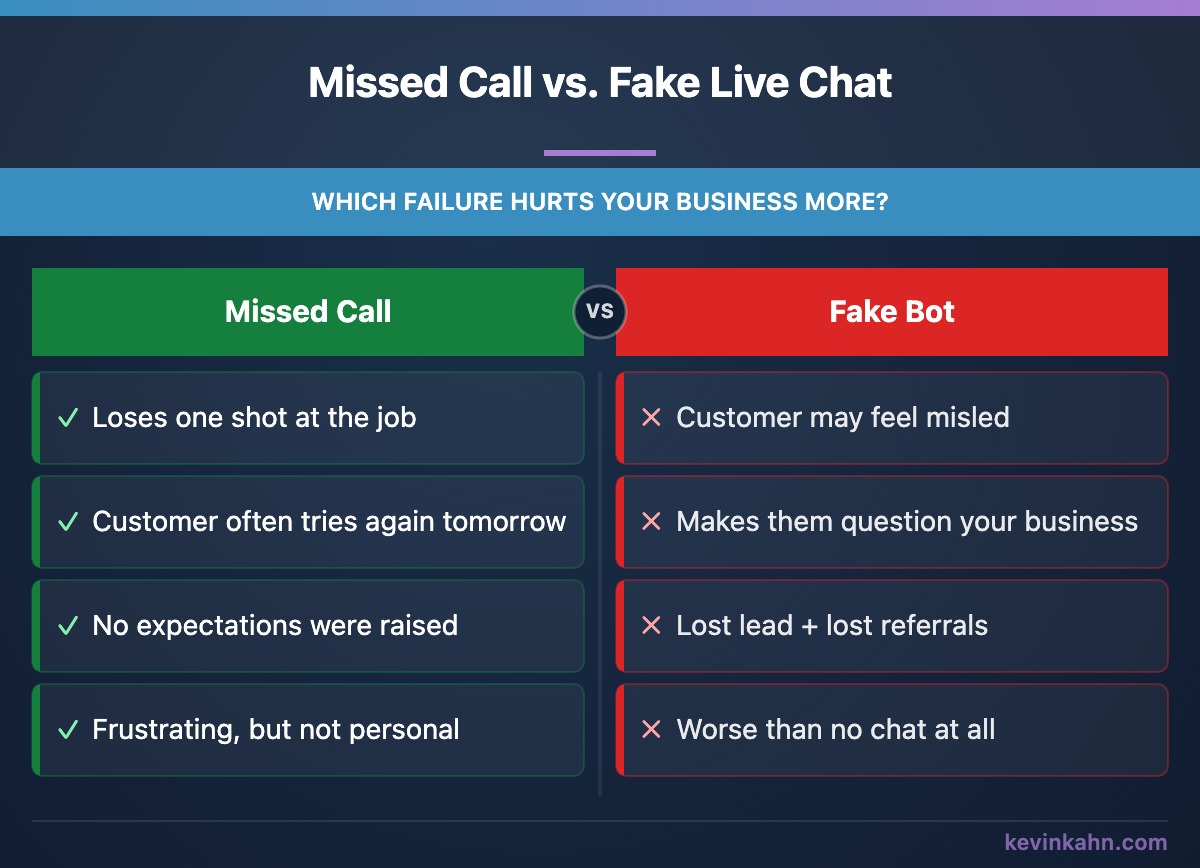
A missed call is a missed opportunity. A bot that lies about being human is something worse: it's a reason not to trust you.
Think about what's actually happening from the prospect's perspective. They come to your site with a real problem. A leaking pipe. A furnace that stopped working. They see a green dot and a name and believe for a moment that someone is there. They ask a real question. They get a pivot. They ask again. Another pivot. Then they ask something direct and the chat ends itself or the "person" contradicts herself.
At that point, the customer isn't just disappointed. They're suspicious. They're wondering what else about this company isn't what it appears to be. Are the reviews real? Is the license current? Is the price they quote on the phone the price they'll charge when the job is done?
You didn't just fail to convert a lead. You gave that person a specific reason to distrust you.
A contractor who misses a call loses one shot. A contractor whose website actively misleads someone loses that customer and probably a few referrals they would have sent. The customer who feels manipulated tells people. The customer who got voicemail just tries again tomorrow.
This is why a live chat widget that misrepresents itself isn't a neutral failure. It's a net negative. The absence of a chat widget would have been better than this. At least then, the customer's expectations were never raised and broken.
What Good After-Hours Coverage Actually Looks Like
The objection I hear from contractors is always the same: "I can't afford to staff someone at 11pm." Fair. Nobody's asking you to. But there's a wide gap between a fake bot and a real employee, and most of the solutions that work live in that gap.
Start with a contact form that has a stated response window. "Submit this and I'll get back to you by 8am" is a real promise you can keep. Set the expectation, meet it.
A two-path intake works for most service businesses. One path for emergencies (burst pipe, no heat in January, active leak), one for everything else. The emergency path routes to a real on-call tech or answering service. The non-emergency path books a morning callback. Be explicit about what counts as an emergency so you're not getting 2am calls about a slow drain.
A scheduling widget is one of the highest-leverage things you can add. Let customers book a real morning slot at 9pm and go to bed knowing they have an appointment. That alone beats most of your competition. Housecall Pro, Jobber, and ServiceTitan all have these built in. Text-back automation for missed calls is another good one. When a call hits voicemail, an automatic text fires back: "Got your call, I'll reach you at 8am. Is this urgent?" Honest, fast, and the customer is interacting with a real dispatcher first thing in the morning.
If you want to use AI, use it as a transparent triage assistant. Open with "I'm a bot. I can collect your info and flag urgent requests for our on-call team. Want to do that?" That framing works because it's true. The customer knows what they're dealing with, the bot does one job well, and a human takes it from there.
The goal isn't to make it look like someone's always available. The goal is to make sure every after-hours contact gets a real, fast, honest response in the morning, and that true emergencies get routed to a real person right now.
A Contact Form That Sets Real Expectations Beats a Fake Chat That Breaks Them
This is really about psychology, not tools.
A contact form that says "I'll reply within one business day" makes a small promise. The contractor can keep that promise easily. The customer submits, gets a confirmation, and goes to bed with no unanswered question about whether someone received their request. That's a good customer experience. Simple, low-tech, and honest.
A fake live chat makes a large implicit promise: a real person is here right now, ready to help you. The moment the customer asks a real question, that promise breaks. And broken promises don't just disappoint people. They make people feel foolish for believing them. Nobody wants to feel like they got played by a contractor's website before the contractor ever picked up the phone.
Trust is built by setting a small expectation and meeting it, not by setting a large one and missing it.
The irony is that contractors add the chat widget to seem more professional. But professionalism isn't a green dot and a stock photo. Professionalism is doing what you said you would do. A contact form with a real response commitment is more professional than a chatbot that can't answer what your trip charge is.
Simpler is more honest. And honest converts better. Every time.
The Contractor Who Texts Back in Five Minutes Wins the Job Almost Every Time
Most contractors in any local market have a genuinely bad after-hours experience. Voicemail boxes that don't get checked until Tuesday. No website form at all. Or a live chat widget for contractors powered by a bot that confirms it can help with alligator moat plumbing.
That's your competition.
You don't need to fake anything to beat them. You need honest intake, a fast text-back, and a real morning callback window. That's it. A homeowner who submits a form at 9pm and gets a text at 9:02 that says "Got it, I'll call you first thing tomorrow" is not calling three other contractors in the morning. They already feel taken care of. You already won the job before you made a single call.
This is exactly how I build websites for contractors and small businesses. Not to impress people with features, but to set up honest systems that actually convert. If your current site is relying on a fake chat to do the heavy lifting, I'd be glad to talk through what a better setup looks like. Reach out here and I'll get back to you the same day.